African lionPanthera leo
Lions are the most social of the big cats, living in family groups called prides.
Fauna · Giza Zoo
100 species are joining Giza Zoo for its reopening. Meet them here first.
Lions are the most social of the big cats, living in family groups called prides.
Smaller-eared than its African cousins, the Asian elephant has a single finger at the tip of its trunk.
The smallest otter species, it finds food by touch with nimble, almost claw-free fingers.
Its roaring calls carry far through Madagascar's rainforest, and it pollinates the traveller's tree as it feeds.
Male blackbucks carry long spiralling horns and turn darker, almost black, as they mature.
Named for the cap of hair parted down the middle of its head; it lives only in southern India.
Every zebra's stripe pattern is unique; Burchell's zebras often show faint shadow stripes between the black ones.
California sea lions can walk on all four flippers, which true seals cannot do.
The world's largest rodent, and a strong swimmer with partly webbed feet.
A cheetah can sprint at around 100 km/h, but only for a few hundred metres.
A walking eland makes a clicking sound with each step that other elands can hear from afar.
Known since antiquity as the ichneumon, it was honoured in ancient Egypt for killing snakes.
An impala can leap about three metres high and cover ten metres in a single bound.
Lar gibbons swing hand over hand through the forest canopy and sing duets at dawn.
Leopards are strong climbers and often haul their meals into trees to keep them from other predators.
Lowland tapir calves are born striped and spotted like watermelons; the pattern fades within months.
Meerkats take turns standing guard while the rest of the group digs for food.
An adult pygmy marmoset weighs little more than 100 grams, making it the smallest monkey known.
Red kangaroos cover ground in long hops and use the tail as a fifth limb when moving slowly.
Red ruffed lemurs live only on the Masoala peninsula in north-eastern Madagascar.
Agoutis bury seeds to eat later and forget some, planting new rainforest trees as they go.
Its coat looks like a net: large russet patches divided by crisp white lines.
A pale desert gazelle of the Sahara's sand seas, at home in Egypt's Western Desert.
Ring-tailed lemurs start cool mornings sunbathing, sitting upright with their arms open to the sun.
Once extinct in the wild, it roams Chad again after a reintroduction that began in 2016.
Long-legged and large-eared, servals find prey by sound and pounce on it in tall grass.
Its rounded, star-shaped patches continue down the legs, getting smaller towards the hooves.
Adult males grow a thick mane and can weigh more than twice as much as females.
Slender, spotted and ring-tailed, genets hunt at night and climb as easily as cats.
Squirrel monkeys live in large, busy troops and use their long tails for balance, not for gripping.
No two tigers have the same stripes, and the pattern continues on the skin beneath the fur.
Wallabies are smaller relatives of kangaroos, and a newborn joey is about the size of a jellybean.
Warthogs kneel on their padded wrists to graze and trot off with their tails held straight up.
The white rhino is a grazer, with a wide, square lip built for cropping short grass.
White wallabies are a rare colour form, best known from a wild population on Bruny Island, Tasmania.
It wears a crown of stiff golden feathers and, unlike other cranes, crowned cranes can roost in trees.
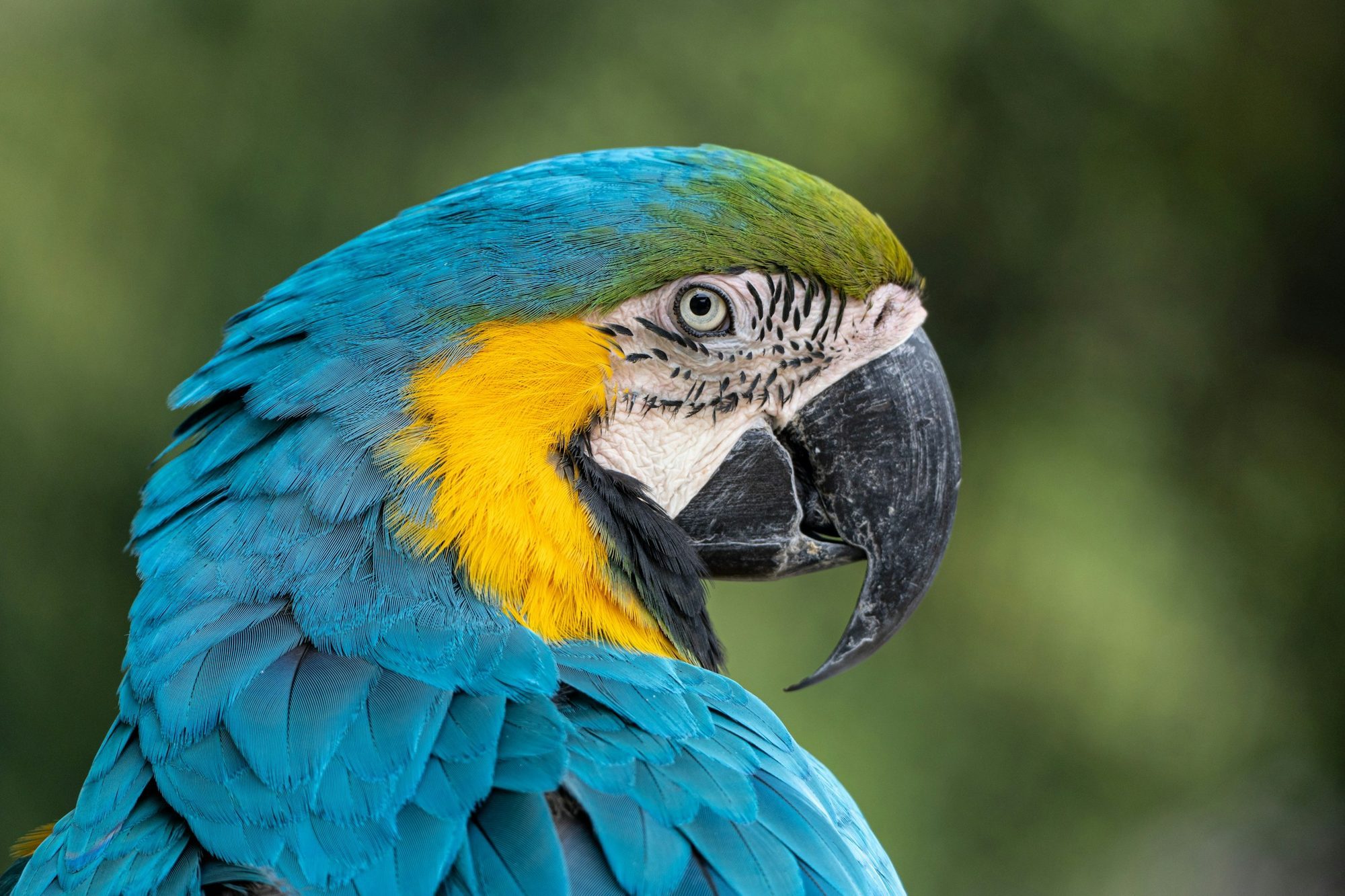
Blue and gold macaws pair for life and can live for fifty years or more in human care.
Caribbean flamingos are a deep coral pink, coloured by pigments in the algae and shrimp they eat.
Crows are among the cleverest birds: they solve puzzles and can remember human faces.
The smallest of the cranes, it makes long migrations between the Eurasian steppes and Africa or India.
Males are bright green and females red and purple, so different they were once thought separate species.
One of the few birds that use tools: it cracks ostrich eggs by throwing stones at them.
Falcons are fast, sharp-eyed hunters; a kestrel can hover in one spot while it scans for prey.
A small, bright parrot from northern Tanzania that lives in flocks and stays close to its partner.
Greater flamingos visit Egypt's lakes and lagoons; their pink comes from pigments in their food.
A large red macaw with green wing bands and a beak strong enough to crack hard nuts.
Unusually for birds of prey, Harris's hawks hunt together in family groups.
Humboldt penguins come from the coasts of Peru and Chile, where they nest in burrows.
A peacock's train is made of long feathers growing from its back, held up by the real tail beneath.
The drake wears orange sail feathers on his back; mandarin ducks nest in tree holes.
It walks the savanna on long legs looking for prey, and has long eyelashes to keep out dust.
Females tuck strips of bark and leaves into their rump feathers to carry them to the nest.
A sandy-coloured owl of rocky deserts and wadis across North Africa and Arabia, with orange-yellow eyes.
Rheas cannot fly; the male builds the nest, incubates the eggs and raises the chicks alone.
This tall African stork appears in ancient Egyptian hieroglyphs; females have yellow eyes, males dark ones.
Scarlet ibises hatch grey-brown and turn red as they grow, coloured by the crustaceans they eat.
A large eagle of open grasslands; thousands pass over Egypt each autumn on their way to Africa.
A golden-yellow parrot from north-eastern South America, where trapping has made it rare in the wild.
The wild ancestor of the domestic Chinese goose, with a long black bill and a two-tone neck.
Its huge orange bill is light and hollow, and helps the bird shed heat.
Named for its white face and its clear three-note whistle, often heard at night.
Whooper swans are named for their loud, bugling calls and have a yellow-and-black bill.
Amazon parrots are stocky, mostly green parrots from the Americas, known for their strong voices.
Once close to disappearing, the American alligator recovered under protection and was delisted in 1987.
When frightened it curls into a tight ball with its head tucked inside, hence the name.
When alarmed it puffs out a spiny throat beard; it also waves an arm to signal to others.
A colour form of the green iguana, bred in human care for its blue skin.
It startles predators by opening its mouth wide and showing a bright blue tongue.
One of the world's largest snakes, it is a good swimmer and can stay underwater for half an hour.
It moves across sand by sidewinding and buries itself until only its eyes and horns show.
A sand-coloured monitor lizard at home in deserts from the Sahara to Central Asia.
A plant-eating desert lizard that blocks its burrow with a thick, spiked tail.
A palm-sized desert tortoise from the Mediterranean coastal deserts of Egypt and Libya.
Green iguanas are leaf-eaters that bask in treetops and drop into water to escape danger.
Hatchlings are bright yellow or brick red and turn green in their first year.
A large lizard of the Nile's banks, as comfortable swimming as it is climbing or running.
It can sprint across the surface of water on its hind legs to escape danger.
Each scale on its high domed shell carries a yellow starburst; it lives only in southern Madagascar.
A colour form of the green iguana, bred in human care for its red-orange skin.
A large lizard from Argentina, Bolivia and Paraguay; males turn deep red and grow heavy jowls.
Named for the horn-like bumps on its snout, it comes from the island of Hispaniola.
It wears a tall crest, or casque, on its head, and comes from Yemen and Saudi Arabia.
Frogs breathe partly through their skin, which is why they need clean water and damp places.
Many salamanders can regrow a lost tail or even a whole limb.
Cichlids are devoted parents; many species shelter their eggs and young inside their mouths.
Koi are ornamental carp, bred in Japan for their colours and patterns for about two centuries.
Butterflies taste with their feet and drink nectar through a coiled tube called a proboscis.
One of the largest scorpions, it glows blue-green under ultraviolet light and has a mild sting.
Alpacas were bred in the Andes for their soft fleece, and they hum to each other.
The Angora goat grows mohair, a long, silky fleece; the breed takes its name from Ankara.
A big, calm chicken breed with feathered feet, developed in the United States from Asian birds.
The hump stores fat, not water; a thirsty dromedary can drink around 100 litres in one go.
Guinea pigs come from the Andes, not Guinea, and make little popcorn jumps when excited.
Jacob sheep are spotted black and white and often carry four horns, sometimes six.
A smaller line of the same miniature cattle, bred at the Nadipathy Goshala in Kakinada, India.
A very small zebu cow bred in Andhra Pradesh, India, from the dwarf Punganur breed.
The smallest of the three Nadipathy lines of miniature zebu cattle from Andhra Pradesh.
A small, sturdy goat breed that began with the dwarf goats of West Africa.
Silkies have fluffy, hair-like feathers, black skin and five toes instead of the usual four.
A shaggy mountain sheep from the Swiss canton of Valais, with a black face, ears, knees and feet.
The photographs show each species. Portraits of our own residents will replace them as the animals settle in. Red List categories are the global assessments of the International Union for Conservation of Nature.